University Magazine Project.
Magazine feature, written, photo elements created in Photoshop and layout in InDesign.
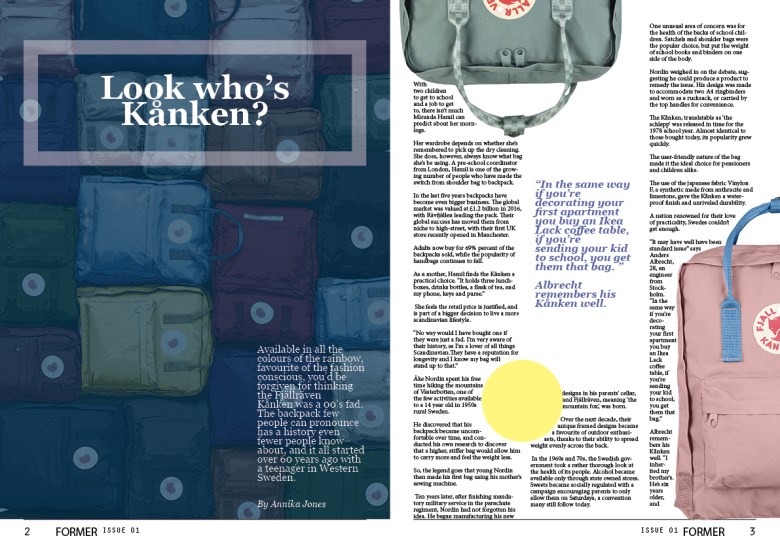

Look who’s kånken?
Available in all the colours of the rainbow, favourite of the fashion conscious, you’d be forgiven for thinking the Fjällräven Kånken was a 00’s fad. The backpack few people can pronounce has a history even fewer people know about, and it all started over 60 years ago with a teenager in Western Sweden.
By Annika Jones
With two children to get to school and a job to get to, there isn’t much Miranda Hamil can predict about her mornings. Her wardrobe depends on whether she’s remembered to pick up the dry cleaning. She does, however, always know what bag she’s be using. A pre-school coordinator from London, Hamil is one of the growing number of people who have made the switch from shoulder bag to backpack
In the last five years backpacks have become even bigger business. The global market was valued at £1.2 billion in 2016, with Rävfjällen leading the pack. Their global success has moved them from niche to high-street, with their first UK store recently opened in Manchester. Adults now buy for 69% percent of the backpacks sold, while the popularity of handbags continues to fall.
As a mother, Hamil finds the Kånken a practical choice. “It holds three lunchboxes, drinks bottles, a flask of tea, and my phone, keys and purse.”
She feels the retail price is justified, and is part of a bigger decision to live a more scandinavian lifestyle. “No way would I have bought one if they were just a fad. I’m very aware of their history, as I’m a lover of all things Scandinavian.They have a reputation for longevity and I know my bag will stand up to that.”
Åke Nordin spent his free time hiking the mountains of Västerbotten, one of the few activities available to a 14 year old in 1950s rural Sweden.
He discovered that his backpack became uncomfortable over time, and conducted his own research to discover that a higher, stiffer bag would allow him to carry more and feel the weight less. So, the legend goes that young Nordin then made his first bag using his mother’s sewing machine.
Ten years later, after finishing mandatory military service in the parachute regiment, Nordin had not forgotten his idea. He began manufacturing his new designs in his parents’ cellar, and Fjällräven, meaning ‘the mountain fox’, was born. Over the next decade, their unique framed designs became a favourite of outdoor enthusiasts, thanks to their ability to spread weight evenly across the back.
In the 1960s and 70s, the Swedish government took a rather thorough look at the health of its people. Alcohol became available only through state owned stores. Sweets became socially regulated with a campaign encouraging parents to only allow them on Saturdays, a convention many still follow today. One unusual area of concern was for the health of the backs of school children. Satchels and shoulder bags were the popular choice, but put the weight of school books and binders on one side of the body.
Nordin weighed in on the debate, suggesting he could produce a product to remedy the issue. His design was made to accommodate two A4 ringbinders and worn as a rucksack, or carried by the top handles for convenience. The Kånken, translatable as ‘the schlepp’ was released in time for the 1978 school year. Almost identical to those bought today, its popularity grew quickly. The user-friendly nature of the bag made it the ideal choice for pensioners and children alike. The use of the japanese fabric Vinylon F, a synthetic made from anthracite and limestone, gave the Kånken a waterproof finish and unrivalled durability. A nation renowned for their love of practicality, Swedes couldn’t get enough.
“It may have well have been standard issue” says Anders Albrecht, 28, an engineer from Stockholm. “In the same way if you’re decorating your first apartment you buy an Ikea Lack coffee table, if you’re sending your kid to school, you get them that bag.” Albrecht remembers his Kånken well. “I inherited my brother’s. He’s six years older, and somehow this bag had lasted him all through primary school, and I’m pretty sure it did the same for me. I think my sisters may still have theirs somewhere, they’re too good to throw away so you’ll find most [Swedish] people have a faded one in the back of a cupboard somewhere for emergencies.”
Maelene Fedderson, a translator from Horsholm, Denmark, agrees. “I had my first 37 years ago, I don’t remember it ever wearing out!”
While Fjällräven has always been a name in outdoor goods, the rise of the Kånken bag as a fashion item did not happen until the early 2010s. Fedderson notes “there was a time when they were considered quite uncool in Denmark, only teachers or childcare workers would use them.”
This changed when niche fashion store ‘Oi Polloi’ became one of the first to stock them in the UK. Speaking to GQ in 2012, founder Steve Sanderson described the origins of the bag as “form following function” in the same way Birkinstocks were first designed as an orthopedic shoe.
He continues “Oi Polloi has a history of re-appropriating these kind of items. They’re brilliant. The functional design, the colours and the fact they were designed as an antidote to kids getting back problems while carrying their books, the Kånken truly is the people’s bag.”
Kånken wearers agree, there’s a coolness to the brand and design that doesn’t come with the average Eastpak or Kipling rucksack.
Albrecht finds their recent popularity irritating: “It annoys me that something so functional is suddenly a fashion statement. I don’t want to look like a hipster parent so I don’t feel like I can buy one for my son, which is a bit perverse really. Most people buy them now because they’re cool, not because they’re the best bags.”
He adds “The other issue is the price. I do not remember how much they cost when I was a kid, but I know my mother would not have paid the kind of money people do now.”
Many argue that the practical product no longer comes at a practical price, with a standard Kånken setting you back around £75.
For Steven Dorey, a learning specialist from Ottawa, the trend for the bags at home in Canada made them the perfect souvenir from a family trip to Scandinavia. “We waited until we got to the flagship store in Stockholm, and were shocked that the prices were the same, if not more than back home.”
Steven’s daughter however, didn’t leave the country empty handed. “Tossed in a box on the floor of a vintage shop, lumped in with a variety of other bags we found a red Kånken. We loved that the logo was somewhat faded, showing the item’s age and use, and that there was a patch sewn onto it from the previous owner. It felt like we’d found a piece of Swedish history.”
Steven says the genuine Fjällräven bag only cost him the equivalent of a few pounds, which made him realise how commonplace these bags must have been. “Our daughter wore it as we traveled through Sweden and Norway and made our way back to Canada. Back home, we sewed on patches of the flags of the Nordic countries we visited. We feel like it’s our daughter’s little authentic Nordic souvenir.”
In the 40 year journey from functional to fashion icon, the bag’s design has not changed, but its status has. The Kånken is now officially recognised as a protected piece of applied art by the Swedish Government’s society of arts and crafts. “Like many products that have become icons over the years, Kånken follows a rule of timelessness and simple design” says head of R&D at Fjällräven, Henrik Andersson. In a time of increasingly disposable clothing, Fjällräven offers the opposite, “you see a lot of old Kånkens that have been passed on from parents to their kids still in use today,” Andersson adds.
The cute bag with a fox logo could easily be mistaken as fast fashion, but those consumers are getting a lot more than they bargained for. As Steve Sanderson says: ”You can have one of these from a really young age, all through school, college, everything in between and beyond.”
Now the Kånken has won its way into our wardrobes, its durability and practicality mean it could have a place there for its next 40 years. As Hamil says: “I see my relationship with my Kånken lasting longer than my marriage did!”
 Annika Jones